

How the Minnesota Community Survey is built for the age of AI
AI bots can complete online surveys undetected. But they can't receive a mailed survey invitation sent to a randomly selected Minnesota address.
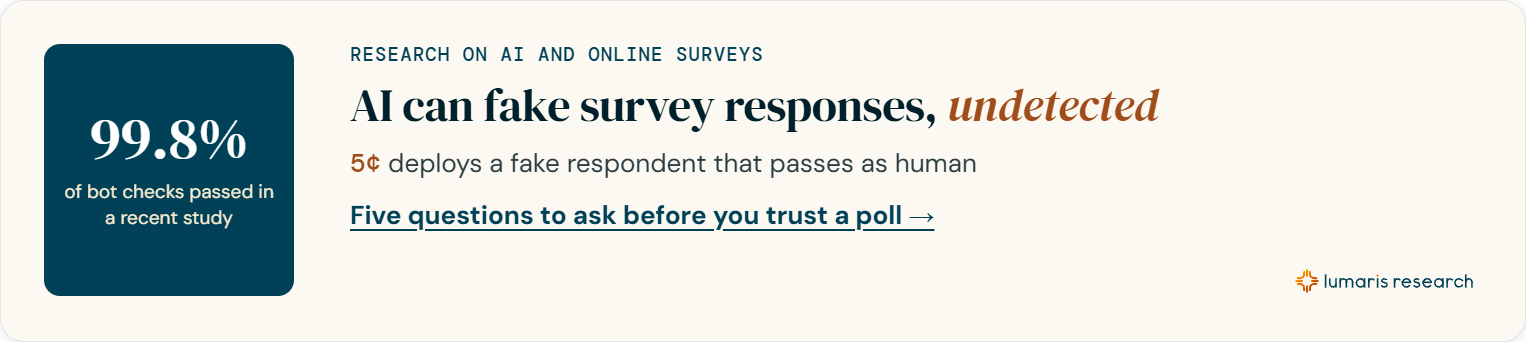
We've written about a study that showed how an AI survey respondent can be built to pass 99.8% of checks designed to catch it. In this post, we explain how our surveys are built to withstand AI bot infiltration.
Our secret? The U.S. Postal Service.
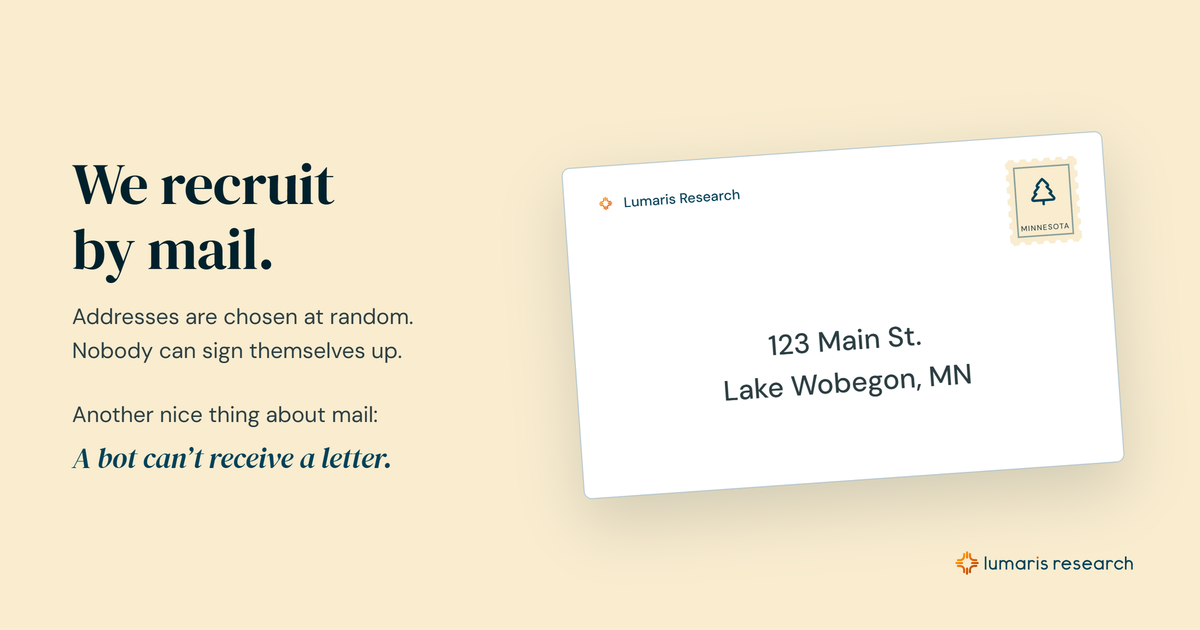
The Minnesota Community Survey panel is built the old-fashioned way – we recruit by mail to randomly selected addresses.
We didn't do this in response to AI threats. We mailed survey invitations because it's the proven way to build probability-based survey panels. It just so happens that this method is also resilient to AI manipulation. After all, a bot can't receive a letter sent to 123 Main St., Lake Wobegon, MN.
In the AI study, the author's prescription is a return to “more controlled recruitment methods, such as address-based sampling,” where “deploying a bot for a single survey is infeasible.”
This sums up our approach fairly well.
Every Minnesota Community Survey panelist is recruited by mail, at an address we selected. Nobody can sign themselves up, and we use U.S. Postal Service data to verify that every mailing reaches a valid residential address.
We survey the same people over time: our panel of about 2,500 Minnesota adults has agreed to take surveys regularly, allowing us to detect inconsistencies that a one-time survey would miss. Each initial invitation carries a unique code tied to that address, and every subsequent survey sent to a panelist comes with a unique single-use code.
A detailed methods statement accompanies every public survey release. These explain how we weight our surveys to represent Minnesota and disclose sample size, field dates, response rates, and margin of error. (Here's an example.)
No survey method is completely immune to future threats. But the Minnesota Community Survey panel was created using the probability-based methods that both guard against AI fraud and have a long record of improving accuracy in survey research.
Published Aug. 11, 2026.

Need survey data you can stake decisions on?
Lumaris Research operates Minnesota's only publicly available probability-based survey panel.


