

Most Minnesotans say last winter’s immigration enforcement surge hurt the state’s economy
Nearly 1 in 10 Minnesota workers had hours cut, missed days, or lost a job, and over 1 in 5 shoppers changed where they go, a statewide survey finds.
By Craig Helmstetter
About this survey
Conducted May 6 to June 16, 2026, online in English or Spanish
1,101 Minnesota adults
Margin of error ±4.43 percentage points
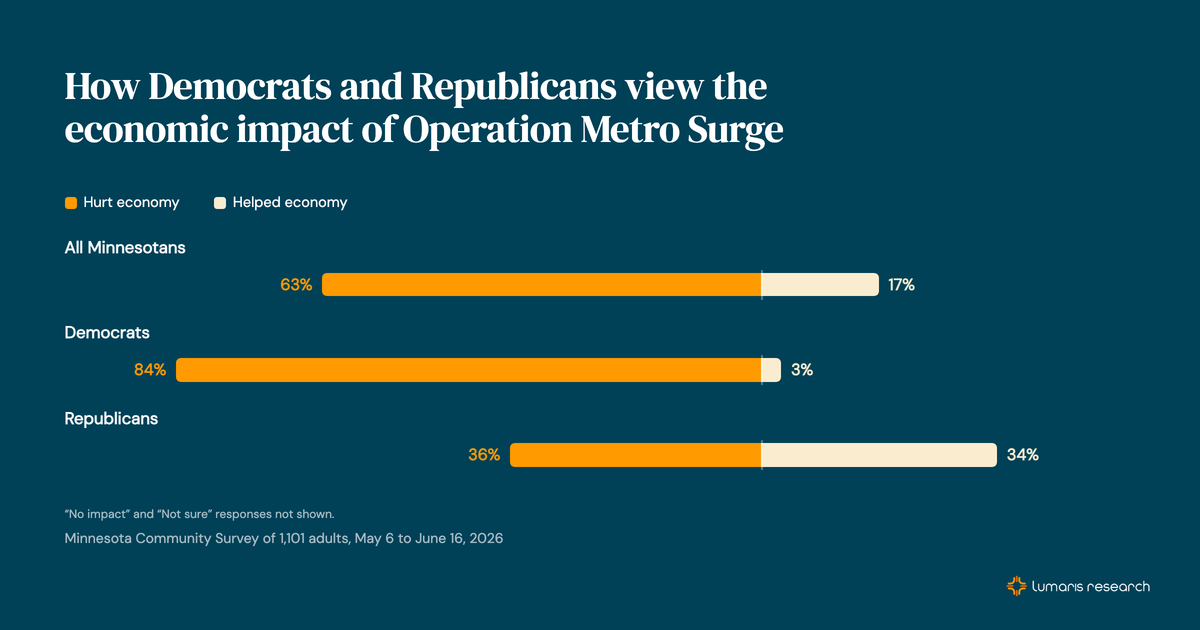
Nearly two-thirds of adult Minnesotans said Operation Metro Surge hurt the state’s economy, according to the Summer 2026 Minnesota Community Survey. The poll asked Minnesotans to assess the surge’s impact on the state’s economy and tourism, and on their own jobs and daily life.
Lumaris Research conducted the study with a representative sample of over 1,000 Minnesota adults from May 6 to June 16, 2026.
Widespread views of economic harm from the federal immigration enforcement surge may reflect the public’s broad opposition to the surge and the actions of federal agents in the shooting deaths of Renee Good and Alex Pretti. However, these views also appear to be grounded in the surge’s impact on the daily lives of Minnesotans. Key findings from the survey include:
- 9% of working adults missed days of work, had their work hours reduced, or lost a job.
- 30% of those who responded said they had family, friends, or coworkers who had their jobs impacted in this way.
- 22% of shoppers said the operation changed where they shopped.
- 16% said they were more likely to shop online.
- 30% said they were more likely to visit immigrant-owned businesses.
- 40% said they were less likely to visit downtown Minneapolis because of Operation Metro Surge, while 10% said they were more likely to visit.
- 40% said they were more likely to “avoid certain parts of Minneapolis.”
- 17% said they considered leaving Minnesota because of the federal surge in immigration enforcement.
- 56% said they thought the surge hurt tourism to Minnesota, compared to 10% who said that it helped.
Employment
Nine percent of working Minnesota adults reported they had experienced at least one of three negative work-related impacts due to Operation Metro Surge.
- 8% said they worked fewer hours.
- Of those, most (60%) said they lost 16 or fewer hours. Another 32% said they lost between 17 and 40 hours of work, and 8% said they lost more than 40 hours.
- 6% said they missed days of work.
- Of those, 38% said they missed 1 or 2 days of work; 45% said they missed 3-5 days, and 18% said they missed 6 or more days of work.
- 3% said they lost their job due to the surge in federal immigration agents.
Much higher proportions witnessed those same job impacts among their family, friends, and coworkers.
The employment impacts of Operation Metro Surge were not shared equally among all Minnesotans. One-third of Hispanic Minnesotans reported impacts to their own jobs, and 83% reported job-related impacts among their family, friends, or coworkers. More broadly, job-related impacts are more common among Minnesotans of color than among non-Hispanic White Minnesotans.
Nearly 1 in 5 immigrants in the state reported impacts to their own jobs due to Operation Metro Surge, and nearly half reported job-related impacts among their family, friends, and coworkers.
While a meaningful share of people living in Greater Minnesota and the suburbs within the Twin Cities seven-county region – 6% for both – experienced surge-related job harms, the proportion was nearly four times higher in the central cities.
Minneapolis and St. Paul are home to some (but not nearly all) of the state’s largest immigrant populations and communities of color, perhaps helping explain why job-related impacts are so much higher there.
Shopping
Over 1 in 5 Minnesota shoppers said that Operation Metro Surge changed where they shopped in person, including:
- Nearly half (47%) of immigrants.
- 2 in 5 Minnesotans of color, including nearly half of all Hispanic Minnesotans and 2 in 5 Black Minnesotans.
- 2 in 5 residents of Minneapolis and St. Paul.
When asked about two specific shopping behaviors, we found that as a result of Operation Metro Surge, Minnesotans, on net, became more likely to visit immigrant-owned businesses and shop online.
In either case, most said that the federal surge made no difference in these behaviors (56% and 80%, respectively). For those who did report changes in behavior:
- Visiting immigrant-owned businesses: 30% said they were more likely to do so, while 13% said less likely, for a net change of +17 percentage points more likely.
- Shopping online: 16% said they were more likely to do so, 3% said less likely, for a net change of +13 percentage points more likely.
Most groups of Minnesotans were more likely to visit immigrant-owned businesses as a result of Operation Metro Surge. For example, half of both Hispanic and Black Minnesotans said they were more likely to visit immigrant-owned businesses, and around 8% said they were less likely to do so, resulting in a 42 percentage-point change for both groups.
One exception was that Republicans and independents who lean toward the Republican Party became less likely to visit immigrant-owned businesses. This is not the case for all Republicans: Most, 65%, said that Operation Metro Surge did not change their likelihood of visiting immigrant-owned businesses, and 9% said they were more likely to do so – but 26% said they were less likely to visit immigrant-owned businesses.
A larger proportion of all of the groups of Minnesotans that we examined in this survey indicated they were more likely to shop online as a result of last winter’s surge in federal immigration agents. This was especially so for Hispanic Minnesotans and immigrants; over one-third of both groups said they were more likely to shop online, while very few of these groups said they were less likely to do so.
Visiting Minneapolis
While federal agents were active in communities across Minnesota during Operation Metro Surge, some of the most high-profile actions took place in Minneapolis. This includes the shootings of both Renee Good and Alex Pretti, as well as the largest protest against the action, which happened on Jan. 23, 2026.
We asked Minnesotans how the surge in federal agents changed their approach to visiting the state’s largest city. About half said that it made no difference. For those who did report changes in behavior, the results suggest greater hesitancy toward at least parts of the city:
- Visiting downtown Minneapolis: 40% said they were less likely to do so, while 10% said more likely, for a net change of -30 percentage points less likely.
- Avoiding certain parts of Minneapolis: 40% said they were more likely to do so, 8% said less likely, for a net change of +32 percentage points more likely.
When it comes to visiting Minneapolis, Operation Metro Surge had less impact on those who live in the central cities of Minneapolis and St. Paul than on other parts of the state. Still, nearly twice the proportion of central city residents said that the surge made them less likely to visit downtown Minneapolis than said it made them more likely to visit: 26% compared to 13%.
Those living in either the suburbs of the seven-county region or the remaining 80 counties that make up Greater Minnesota were more reluctant to visit downtown Minneapolis after the surge: over 40% of both groups said less likely, while only 10% or less said they were more likely to visit.
As a group, Republicans and independents who lean Republican were particularly reluctant to visit downtown Minneapolis, netting 46 percentage points in the direction of less likely to visit. That group was also the most likely to avoid visiting “certain parts of Minneapolis.”
The only group to indicate that, on net, they are less likely to avoid certain parts of Minneapolis following the surge is Black Minnesotans. While our sample size of Black Minnesotans is not large (unweighted n=80), it is notable that a larger proportion of them said the surge made them less likely to avoid certain Minneapolis neighborhoods than said more likely (32% compared to 27%, for a net 5 percentage point difference).
Moving out of state
About 1 in 6 adult Minnesotans (17%) thought about leaving the state due to Operation Metro Surge. This impact was fairly widespread, with similar shares of both Republicans and Democrats saying so, as well as only slightly fewer residents of Greater Minnesota.
Immigrants were especially likely to say they considered leaving: 37% of Minnesotans born outside of the U.S. considered leaving the state due to the surge in federal immigration agents. This was also the case for 35% of Hispanic Minnesotans, 27% of Black Minnesotans, and 26% of Asian Minnesotans.
Our survey also shows that while many who considered leaving only thought about it, others took steps toward leaving, including talking to family (44%), looking for housing (35%), and looking for a job outside of the state (21%).
Fifteen respondents mentioned steps toward leaving the state not included in the survey’s listed options, including moving to Canada and securing passports.
Economics and tourism
As noted earlier, nearly two-thirds of adult Minnesotans said that Operation Metro Surge harmed the state’s economy. In addition, over half (56%) said that it harmed tourism to Minnesota, including one-third who said it “hurt a great deal.”
Ten percent said the federal surge helped tourism to the state, while 12% said it had no impact and 20% were not sure.
Minnesotans from all parts of the state said that Operation Metro Surge, on balance, harmed both the economy and tourism. For example, 70% of those in the suburbs of the seven-county Twin Cities region said that the operation hurt the state’s economy, and 50% of those living in Greater Minnesota said the surge hurt tourism.
Republicans, including independents who lean Republican, expressed the most support for various aspects of Operation Metro Surge. Even so, Republicans were about as likely to say the operation hurt Minnesota’s economy as to say it helped — and a plurality said it hurt tourism to the state.
Here’s how views of the surge’s impact on the economy and tourism break down by group — the two track closely for nearly every group.
Craig Helmstetter, Ph.D., is a consulting researcher. He is a member of the American Association for Public Opinion Research and American Sociological Association. Helmstetter was the founding managing partner of the APM Research Lab, and former director of Wilder Research’s Minnesota Compass.

Need survey data you can stake decisions on?
Lumaris Research operates Minnesota's only publicly available probability-based survey panel.
About this survey
Conducted May 6 to June 16, 2026, online in English or Spanish
Every respondent was first recruited by mail from a random sample of Minnesota addresses (a probability-based sample). We weighted the results to match Minnesota adults. Some questions were asked of fewer people; each chart shows its own count.
We follow the transparency standards of the American Association for Public Opinion Research. Our published methods and research on survey quality are at lumaris.com/methods.
This survey was paid for by Lumaris Research.
Full methods for this survey Terminology
Question wording
Asked of all respondents
Effect on the state's economy
Thinking back to last winter's surge in federal immigration agents in Minnesota, what impact has this had on the state's economy?
Asked of all respondents
Effect on the state's tourism
What impact has last winter's surge of federal immigration agents had on the state's tourism?
Asked of all respondents
Impacts on you
Did last winter's surge in federal immigration agents cause you to…
Asked of all respondents
Impacts on family, friends or coworkers
Did any family, friends or coworkers have any of the following happen because of the surge of federal immigration agents?
Asked of all respondents
Changes in behavior
Compared to before last winter's surge in federal immigration agents in Minnesota, are you MORE or LESS likely today to…
Asked of respondents who said they personally missed days of work
You said you missed work due to the surge in federal immigration agents. About how many days of work did you miss?
Asked of respondents who said they personally worked fewer hours
You said you worked fewer hours due to the surge in federal agents. About how many fewer hours did you work?
Asked of those who considered leaving Minnesota
Which of the following steps, if any, have you taken to leave Minnesota? Select all that apply.
Comments ()