
Minnesotans say their state is headed in the wrong direction, no matter who you ask
Reserve your spot for the Feb. 25 briefing led by Helmstetter, author of the report.
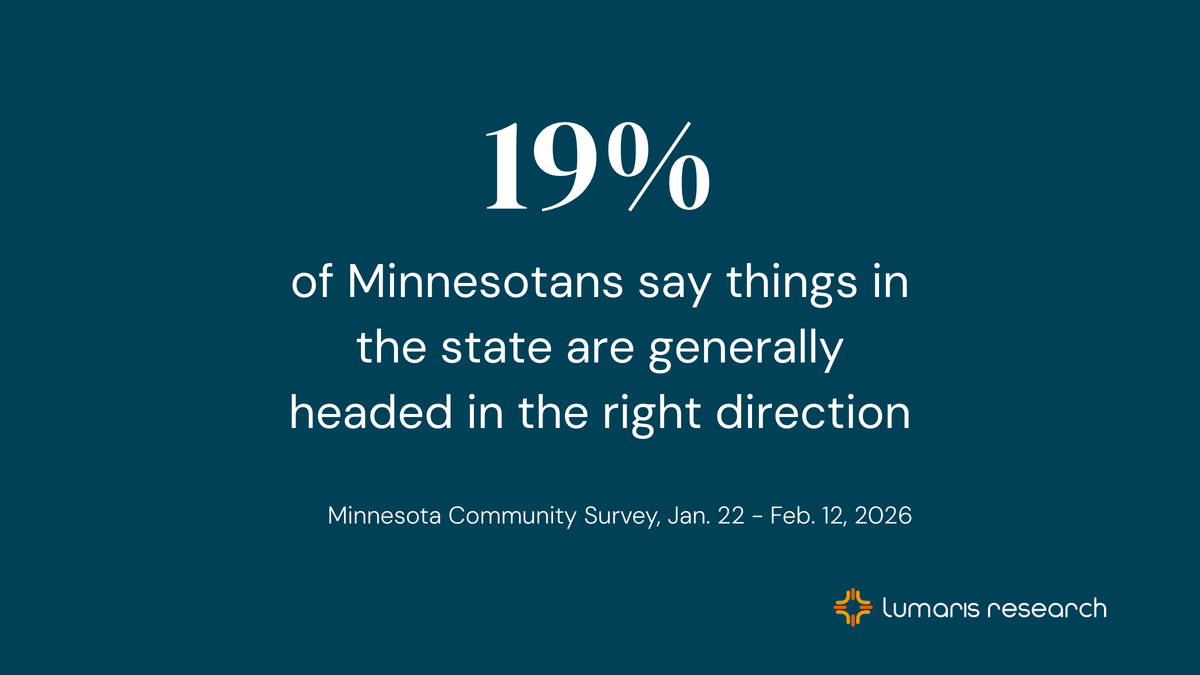
Nearly six in 10 Minnesota adults (58%) say the state is headed in the wrong direction, while just 19% say things are on the right track, according to a Minnesota Community Survey of 1,072 adults conducted by Lumaris Research from Jan. 22 to Feb. 12, 2026.
Not a single demographic group in our survey is net positive on Minnesota's direction, and neither party can muster much optimism.
The snapshot
Partisanship is a strong predictor of how Minnesotans feel, but the story doesn't end there. Republicans overwhelmingly (78%) say the state is headed in the wrong direction, which makes sense given that Democrats control the governorship, hold the edge in the Senate, and are tied with Republicans in the House.
But in this case, being the party (mostly) in power doesn’t produce much of a boost: Just 28% of Democrats say the state is headed in the "right direction," while 41% say "wrong direction." Another 29% said they aren't sure.
RELATED: Minnesotans opposed Operation Metro Surge by a wide margin, most said it made communities less safe
The backdrop
Our survey was in the field during Operation Metro Surge – one of the most disruptive periods in the state's recent history – and less than a year after the assassination of former Minnesota House DFL Leader Melissa Hortman and the attempted killing of DFL Sen. John Hoffman.
During the weeks our survey was live, Minnesotans were grappling with the fatal shootings of two U.S. citizens by federal agents, mass protests, school closures, and a call for a nationwide general strike.
RELATED: 3 in 4 Minnesotans say political violence is a big problem. How much worse will it get?
Who thinks what
Income shows a wide gap. Lower-income Minnesotans are generally more pessimistic than higher earners.
Suburbs lean negative. Six in 10 suburban residents say the state is headed in the wrong direction. That's notable given that suburban voters are often seen as the state's political bellwether.
Young adults are the most optimistic, but not by much. Three in 10 adults ages 18-29 say the state is headed in the right direction, higher than some other groups. Still, they fall well short of a majority.
What this tells us
Wrong-direction numbers above 50% aren't unusual in our polarized era. A national Reuters/Ipsos survey conducted Feb. 13-16, 2026, found 64% of Americans say the country is on the "wrong track."
Partisan patterns between the national poll and our survey tell a revealing story. Nationally, the party that controls the White House gets a boost: 48% of Republicans say the country is headed in the right direction, while just 3% of Democrats agree.
You might expect that dynamic to work in reverse in Minnesota, where Democrats control the governorship and hold a narrow legislative edge. And it does, but weakly: Just 28% of Minnesota Democrats say the state is headed in the right direction, compared with 9% of Republicans.
For context, in 2023, 53% of Wisconsin Democrats said their state was on the right track under a Democratic governor and a Republican legislature. Minnesota Democrats today are 25 points below that level.
Our survey didn't ask people why they answered the way they did. But the survey's field period tells its own story. What Minnesotans were living through goes a long way toward explaining why pessimism cut across party lines.
The fact that 41% of Democrats say "wrong direction" even as their party holds the governorship suggests pessimism that runs deeper than partisan scorekeeping, likely reflecting some combination of Operation Metro Surge, fraud scandals, and a sense of turbulence that Gov. Tim Walz's decision not to seek reelection has done little to settle.
About this Minnesota Community Survey
Survey type: Probability online survey panel
Respondents: 1,072 Minnesota adults
Field dates: Jan. 22–Feb. 12, 2025
Margin of error: ±4.3 percentage points
Languages: English, Spanish
This survey was paid for by Lumaris Research.
Our terminology page has definitions of income tiers, racial and ethnic groups, education levels and geographic regions.
QUESTION WORDING
ASK ALL
MNDIRECT Overall, would you say things in Minnesota are generally headed in the…
Right direction
Wrong direction
Not sure
Comments ()