
Minnesotans opposed Operation Metro Surge by a wide margin, most said it made communities less safe
💡 Join us on Wednesday, Feb. 25, for a briefing on our statewide survey data about the immigration enforcement surge. Craig Helmstetter will discuss findings from this report, plus release new survey data related to the surge.
Reserve your spot for the Feb. 25 briefing led by Helmstetter, author of this report.
By Craig Helmstetter
As Operation Metro Surge winds down, Minnesotans are assessing the impact of some 3,000 federal immigration agents who started arriving in the state in December 2025. The White House has claimed success, citing more than 4,000 arrests and increased public safety.
The presence of federal agents sparked pushback from the start, and opposition intensified nationwide after agents shot and killed two Minnesotans, Renee Good and Alex Pretti. Minnesotans mobilized support networks and organized large-scale protests. Yet vocal opposition does not always reflect Minnesota’s diversity of views.
A new Minnesota Community Survey from Lumaris Research, conducted Jan. 22 to Feb. 12, is the first probability-based survey – the type that uses a random sample of a population – to measure statewide views of Operation Metro Surge. The poll of 1,072 Minnesota adults found:
- 54% of Minnesotans opposed the heightened presence of federal immigration agents, while 31% supported the increase and 15% were not sure.
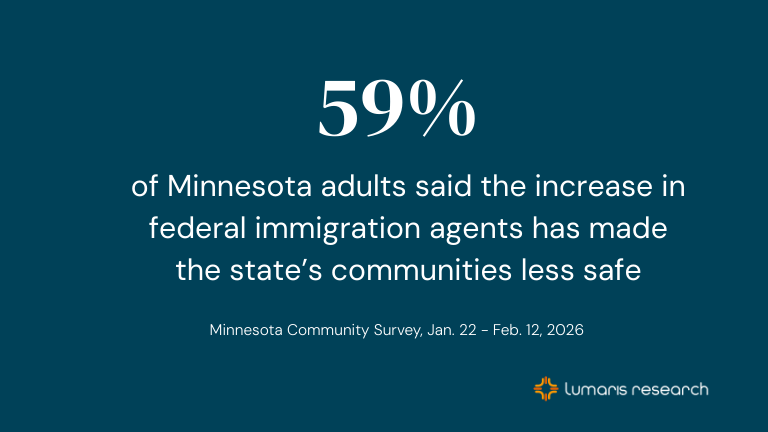
- 59% said the surge made the state less safe, while 26% said it made Minnesota more safe.
- 1 in 3 Minnesotans worried that someone close to them could be arrested by federal immigration agents, including 64% of Minnesotans of color and 62% of immigrants.
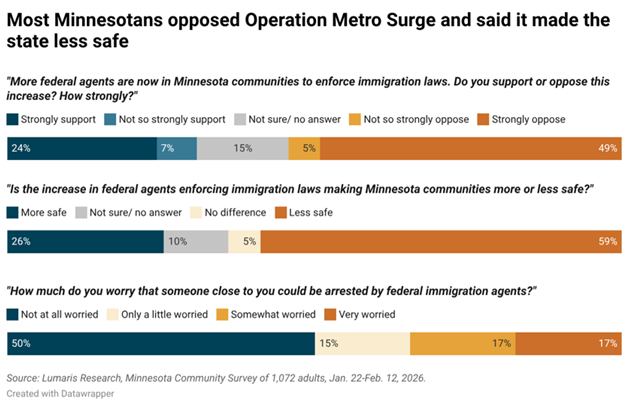
Minnesotans’ responses to these questions differ along lines of political affiliation, race, immigrant status and where they live in the state.
Views of Operation Metro Surge split sharply by 2024 vote
Minnesotans who voted for President Donald Trump in 2024 voiced the strongest support (72%) for the surge in immigration agents. However, an even higher share of Kamala Harris voters (92%) opposed it, as did 56% of non-voters.
Community safety: About 9 in 10 who voted for Harris said that Operation Metro Surge made Minnesota less safe. While a far lower share of Trump voters agreed, a sizeable minority – about 1 in 5 – also said that the surge made communities less safe.
- 60% of Trump voters said the increase in federal agents enforcing immigration laws made the state more safe.
Arrest worries: Personal worries about loved ones being arrested were far more prevalent among Harris voters (49%) and non-voters (43%) than among Trump voters (9%).
- Nearly 1 in 4 Harris voters and non-voters said they were “very worried” that someone close to them could be arrested by federal immigration agents.
The vast majority of Trump voters (82%) said they were “not at all worried” that someone close to them could be arrested, compared with less than half of Harris voters and non-voters.
Heightened concerns about surge among Minnesotans of color, immigrants
Federal officials said the enforcement surge targeted immigrants with criminal records. However, reporting showed that people of color, including Indigenous Minnesotans, were arrested, as were legal immigrants.
The survey found that:
- 2 in 3 Minnesotans of color opposed the increase of federal agents, compared to half of non-Hispanic White Minnesotans.
- 63% of immigrants opposed the increase of federal agents, compared to 54% of U.S.-born Minnesotans.
Consensus on community safety: Majorities of White adults and Minnesotans of color said the immigration surge made their communities less safe. Majorities of U.S.-born and immigrant Minnesotans said the same.
- About 1 in 5 immigrants said the enforcement surge made communities more safe, as did 13% of Minnesotans of color.
Heightened arrest worries: About 6 in 10 Minnesotans of color (64%) and immigrants (62%) said they worried that someone close to them could be arrested by federal immigration agents. By contrast, 27% of White Minnesotans had this worry.
- 50% of immigrants said they were “very worried” that someone close to them could be arrested by federal immigration agents, compared to 15% of U.S.-born Minnesotans.
Worries over arrests varied by racial and ethnic groups. Among Minnesotans of color, individual groups had fewer than 70 respondents, so differences between them should be interpreted with caution.
-
Among Hispanic Minnesotans, 62% were “very worried” about an arrest, compared with 47% of Asian and 35% of Black Minnesotans. Differences between these groups are not statistically significant.
-
11% of White Minnesotans were “very worried” about an arrest, a lower share than among Hispanic and Asian Minnesotans.
Support for surge highest in Greater Minnesota, though views divided
While Operation Metro Surge centered on Minneapolis, arrests and patrols also took place in the Twin Cities suburbs and the rest of the state, including St. Cloud, Willmar and Worthington.
Opposition to the surge in federal immigration agents ranged from 70% in Minneapolis and St. Paul to 56% in the Twin Cities suburbs, and 47% in Greater Minnesota.
Conversely, support for the operation was highest in Greater Minnesota (37%), followed by the Twin Cities suburbs (28%) and then Minneapolis and St. Paul (18%).
(Suburbs include Anoka, Carver, Dakota, Scott, and Washington counties, plus Hennepin and Ramsey counties, excluding Minneapolis and St. Paul.)
Community safety: About half or more of the state’s three major geographic areas said that Operation Metro Surge made communities in Minnesota less safe.
Arrest worries: Worries that someone close to them could face arrest were most prevalent in Minneapolis and St. Paul. Still, about 1 in 3 in the Twin Cities suburbs and nearly 3 in 10 in Greater Minnesota shared that concern.
What this tells us
This survey offers the first probability-based measure of how Minnesotans experienced Operation Metro Surge. The findings reveal broad opposition and widespread concerns that cut across the state's geography. Yet Minnesotans also reacted to the enforcement surge differently depending on their politics, their race, and where they live.
Craig Helmstetter, Ph.D., is a consulting researcher. He was APM Research Lab's founding Managing Partner and led the organization until 2025. A member of the American Association for Public Opinion Research, he serves on its Transparency Initiative Coordinating Committee.
About this Minnesota Community Survey
Survey type: Probability online survey panel
Respondents: 1,072 Minnesota adults
Field dates: Jan. 22–Feb. 12, 2025
Margin of error: ±4.3 percentage points
Languages: English, Spanish
This survey was paid for by Lumaris Research.
Our terminology page has definitions of income tiers, racial and ethnic groups, education levels and geographic regions.
QUESTION WORDING
ASK ALL
IMMENF More federal agents are now in Minnesota communities to enforce immigration laws. Do you support or oppose this increase?
Support
Oppose
Not sure
IMMENF_STR Do you [IF IMMENF=1 INSERT “support”; IF IMMENF=2 INSERT “oppose”] this strongly or not so strongly?
Strongly
Not so strongly
ASK ALL
IMMSAFE Is the increase in federal agents enforcing immigration laws making Minnesota communities more or less safe?
More safe
Less safe
No difference
Not sure
ASK ALL
ARRWORRY How much do you worry that someone close to you could be arrested by federal immigration agents?
Very worried
Somewhat worried
Only a little worried
Not at all worried
Comments ()