
3 in 4 Minnesotans say political violence is a big problem. How much worse will it get?
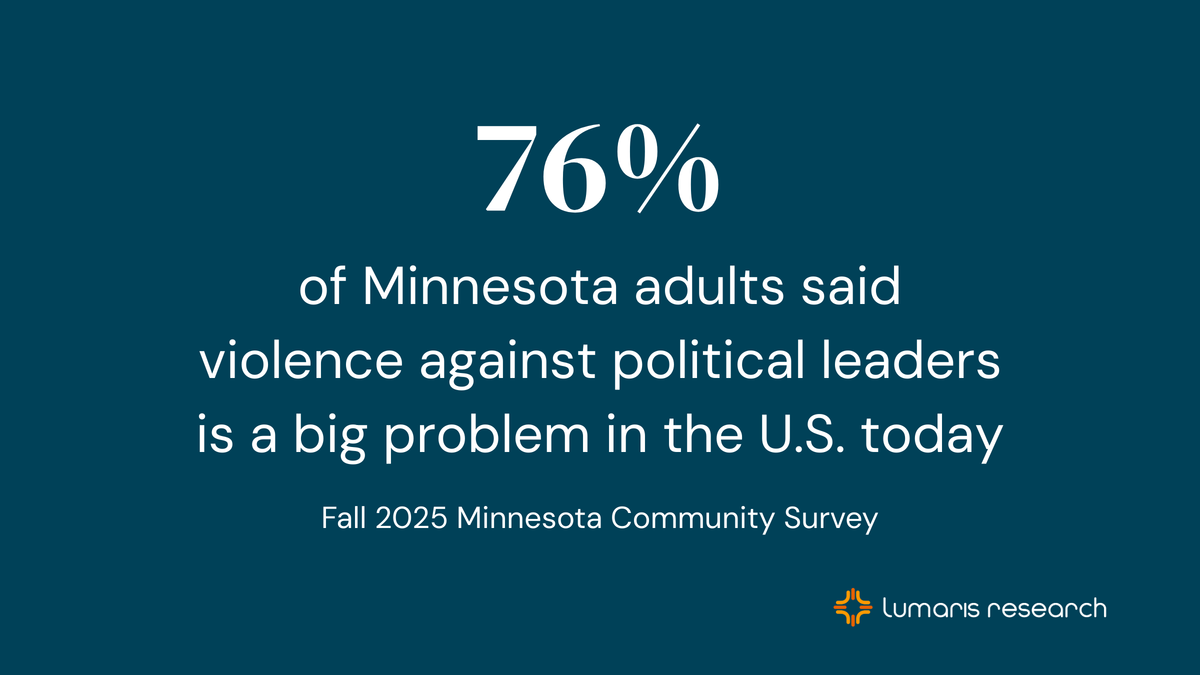
As the 2026 election cycle begins, the vast majority of Minnesota Republicans and Democrats agree that violence directed at political leaders is a big problem in the United States today, according to a statewide survey of 1,172 adults conducted Sept. 25-Nov. 6, 2025.
However, Minnesota’s partisans differed on whether the problem will worsen. Those who voted for Kamala Harris in the 2024 presidential election were more pessimistic than Donald Trump voters about the prospect of political violence in the coming years.
The fall survey was conducted in the aftermath of the assassination of former Minnesota House DFL Leader Melissa Hortman and the attempted killing of DFL Sen. John Hoffman, and just weeks after the September 2025 assassination of conservative activist Charlie Kirk in Utah.
Minnesota’s legislature will convene Feb. 17 for the first time since Hortman’s death. Metal detectors and weapons screening will be in place at the Capitol for the opening gavel. Other security measures include hiring 20 new state troopers, reducing the number of public entrances, and adding more doorways that require security badges.
Violence against elected officials has already generated headlines in the new year. In late January, U.S. Rep. Ilhan Omar, D-Minn., was attacked at a Minneapolis town hall. Nationally, one of President Trump’s would-be assassins has been sentenced to life in prison.
The snapshot
Three-quarters of Minnesota adults (76%) said violence against political leaders is a big problem in the U.S. today. This concern spans the political spectrum: just four points separate Republicans (79%) and Democrats (75%).
Similar shares of Trump and Harris voters called political violence a big problem (85% vs. 81%). But Harris voters were more pessimistic about what comes next:
- 73% of Harris voters expected political violence to become a greater problem in the next few years, compared with 59% of Trump voters – a 14-point gap. Notably, a majority of both groups said they expect violence to go up.
- Harris voters were more likely to expect violence to be a “much greater” problem in the years ahead (32% vs. 22%).
- Overall, 62% of Minnesotans said they expect political violence to be a greater problem in coming years.
Worth noting: Non-voters stood apart. Half (50%) of Minnesotans who did not vote in 2024 said political violence is a big problem, 26 points lower than the state overall. This suggests that Minnesotans who follow politics closely may be more alarmed by what they're seeing than more casual observers.
The backdrop
Minnesota and the United States face a rising tide of political threats and violence.
In Minnesota, threats at the Capitol more than doubled in 2025 compared with the previous year. (The St. Cloud Times compiled a list of attacks against Minnesota politicians going back to 1991.)
Threats and attacks have also been growing nationwide:
-
The number of threats investigated by the U.S. Capitol Police has doubled in recent years, from 7,501 cases in 2022 to 14,938 cases in 2025.
-
Between 2016 and 2025, “there were 25 attacks and plots targeting elected officials, political candidates, judges, political staff, and other government employees motivated by extremist partisan beliefs,” according to the Center for Strategic and International Studies. Only two attacks happened in the two decades preceding 2016.
Looking ahead: Research shows threats against U.S. public officials spiked in the weeks leading up to Election Day in 2024. As the 2026 elections approach, security concerns are changing how candidates campaign: Fewer parades and outdoor events, bulletproof glass installed at offices and residences, and increased daily security.
The takeaway
The four-point gap between Minnesota Republicans and Democrats in viewing political violence as a big problem reveals something rare in American politics: consensus on a pressing national concern.
However, Minnesotans likely have different explanations for what's driving this violence. When Americans were asked to give reasons for political violence, a Pew Research Center report found “Democrats are more likely to mention President Donald Trump, Republicans or MAGA as reasons than Republicans are to cite Democrats, the Democratic Party or liberals.”
This suggests that while Minnesotans agree on political violence being a major problem, they may disagree on its causes and solutions, a divergence that could sharpen as the 2026 midterms approach.
About this Minnesota Community Survey
Survey type: Probability online survey panel
Respondents: 1,172 Minnesota adults
Field dates: Sept. 25–Nov. 6, 2025 (primary fieldwork: Oct. 1-31, 2025)
Margin of error: ±3.86 percentage points
Languages: English, Spanish
This survey was paid for by Lumaris Research.
Our terminology page has definitions of income tiers, racial and ethnic groups, education levels and geographic regions.
QUESTION WORDING
ASK ALL
POLVIOLENCE How big of a problem do you think violence against political leaders is in the country today?
A very big problem
A moderately big problem
A small problem
Not a problem at all
Not sure
ASK ALL
POLVIOLENCEFUT Looking ahead to the next few years, compared with today, do you think the problem of violence against political leaders in the country will be…
Much greater
Somewhat greater
About the same as today
Somewhat less
Much less
Not sure
Comments ()