North Star Promise earns broad support among Minnesotans
A clear majority have an at least somewhat favorable view of the state's new college financial aid program.
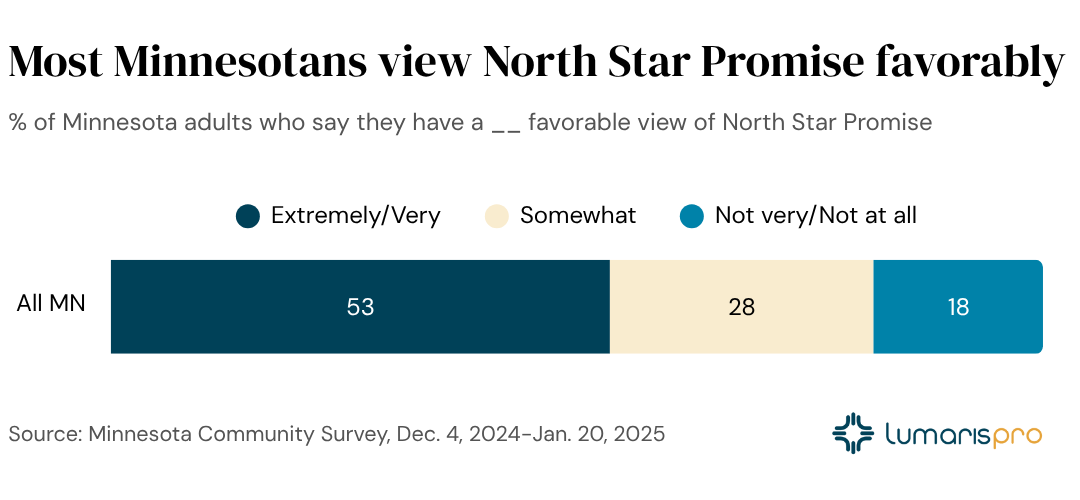
Most Minnesotans favor the state's new college financial aid program, with support spanning political parties, income levels, and geographic regions, according to a Minnesota Community Survey of 1,477 adults conducted Dec. 4, 2024–Jan. 20, 2025.
What we found:
- 81% of Minnesota adults view North Star Promise favorably (53% extremely/strongly, 28% somewhat)
- Just 18% hold unfavorable views of the program
- 92% of Democrats and 68% of Republicans at least somewhat favor the program
What North Star Promise does: The program awards financial aid to students at Minnesota public colleges and Tribal colleges whose families earn less than $80,000 annually.
Over 53,000 Minnesota residents used the program during the 2024-25 school year, according to preliminary data on the program’s first year.
North Star Promise launched in fall 2024 and contributed to enrollment increases at the University of Minnesota and Minnesota State systems, helping reverse years of declining enrollment at Minnesota’s public colleges.
The program addresses bipartisan concerns about college affordability. At the same time, research shows college costs have been falling for almost everyone.
About the Minnesota Community Survey
Survey type: Representative online survey panel
Respondents: 1,477 Minnesota adults
Field dates: Dec. 4 to Jan. 20, 2025.
Our extended field period ensures we reach a representative sample of Minnesotans, not just the quickest responders.
Margin of error: ± 3.35 percentage points
Languages: English, Spanish
Our terminology page has definitions of income tiers, racial and ethnic groups, education levels and geographic regions.
QUESTION WORDING
ASK ALL
Thinking about business conditions in Minnesota…
How would you rate current business conditions in Minnesota?
1 Extremely good
2 Very good
3 Somewhat good
4 Not very good
5 Not at all good
Who supports it most strongly:
- Young adults ages 18-29 (79% very/extremely favorable view)
- Hispanic adults (75%)
- Asian adults (72%)
- Democrats/Harris voters (70% each)
- Lower-income households under $30,000 (69%)
- Immigrants (66%)
- Minneapolis/St. Paul residents (63%)
Where opposition is (somewhat) higher:
- Trump voters (38% not very/not at all favorably)
- Republicans (35%)
- Upper-income households earning $150,000+ (29%)
Why the demographics matter: Support is strongest among groups that face the highest barriers to college access. This includes young adults, a group navigating record student debt levels, as well as Black and Latino Minnesotans.

How North Star Promise compares: Minnesota joins a growing landscape of state-funded tuition programs offering free college to families at both two- and four-year institutions.
As one of the newest programs, it stands out for offering access to both two- and four-year institutions, as well as automatic eligibility through FAFSA and minimal enrollment requirements. This makes it among the most accessible programs of its type in the nation.
What's next: Request detailed breakdowns by region and demographic group to inform your education initiatives. Contact Lumaris Research at info@lumaris.com.
We want to hear from you
Thoughts, questions, or ideas? Send us a message at info@lumaris.com or leave a comment.
Comments ()