Most Minnesotans support legal cannabis, but few say it has made things better
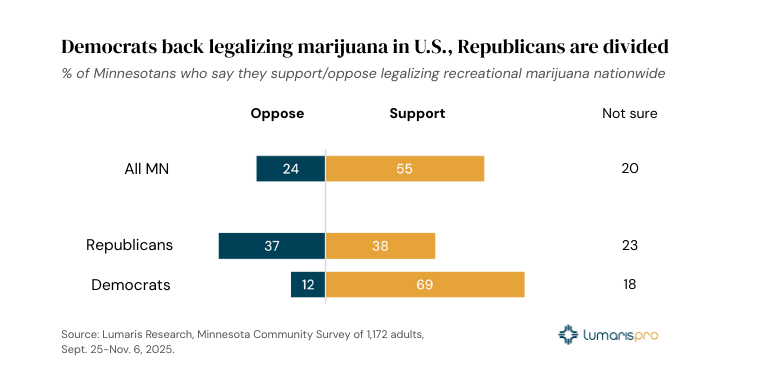
Minnesotans broadly support legal cannabis, but most say it hasn't changed their daily lives, according to a Minnesota Community Survey of 1,172 adults conducted Sept. 25 to Nov. 6, 2025.
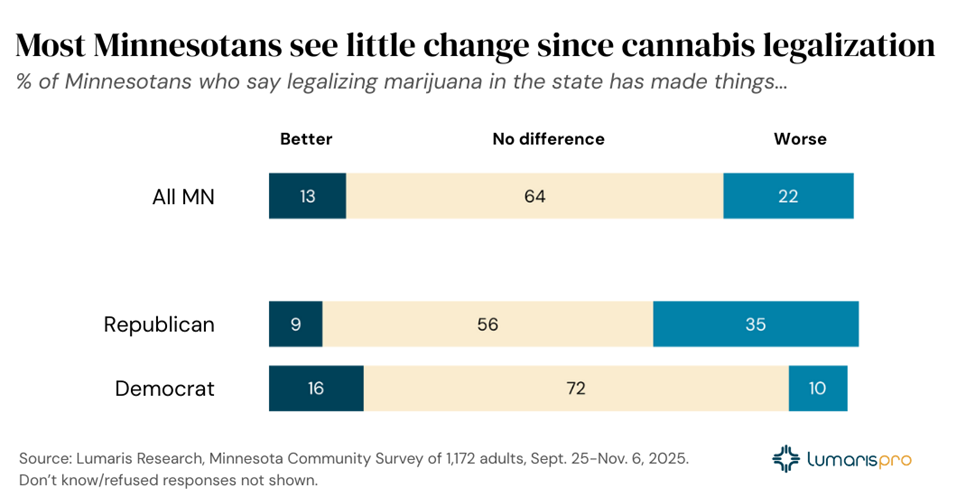
On one thing, partisans agree: Majorities of both Republicans and Democrats say legalization has made "no difference" in their daily lives.
Where they diverge is on legalization itself and its effects. Democrats support legalization at nearly twice the rate of Republicans. While a majority of both Republicans and Democrats said that legalization has not changed things, Republicans are more likely to say it has made things worse.
The timing matters: Our survey was conducted weeks after Minnesota's first state-licensed dispensaries opened in September 2025. In 2023, the state legalized recreational marijuana for adults. With dispensaries open just weeks before our survey, opinions may shift as retail access expands.
Related: Who uses marijuana in Minnesota?
The landscape
Minnesotans’ support for legalization may have softened over the past year, though a precise comparison isn’t available. A September 2024 Star Tribune/MPR News/KARE 11 poll of likely voters found 61% support for legalizing recreational marijuana nationwide, six points higher than in our fall 2025 survey of all Minnesota adults. (The difference in survey populations makes this an imperfect comparison.)
National polling tells a similar story. Support for cannabis legalization has declined modestly, driven by a drop among Republicans, according to an October 2025 Gallup poll. And Americans were far more likely to say marijuana should be legal than to say legalization has had positive effects on communities, a 2024 Pew Research Center survey found.
The backdrop
In the news: The U.S. may reclassify marijuana as a less dangerous drug under an executive order recently signed by President Trump. The policy change would facilitate medical research and allow for business tax credits.
Supporters of legalization in Minnesota highlighted the potential for economic growth. When signing the bill into law, Gov. Tim Walz said legalizing cannabis would expand the economy and create jobs.
Backers also said the law would address racial disparities in enforcement. The law expunged about 57,000 misdemeanor cannabis convictions.
Opponents said legalization would cause real harm. Republicans said the policy would promote addiction and increase traffic deaths.
The breakdown
Race and ethnicity
Asian Minnesotans stand out for uncertainty rather than opposition. Nearly half chose "not sure" on legalization, more than double the statewide rate. Foreign-born residents show a similar pattern.
What might explain this? Two possibilities:
- Information gaps: These communities may not have received cannabis policy information through channels they trust or in languages they prefer.
- Immigration risk: Under federal law, cannabis use can affect immigration status, even in states where it's legal. This creates real stakes for non-citizens regardless of personal attitudes.

Household income
Lower-income Minnesotans use cannabis at twice the rate of the highest earners and are three times more likely to say legalization made things better.
Geography
The Twin Cities suburbs are more negative about the effects of cannabis legalization (26% worse, 5% better), while Minneapolis and St. Paul residents are more evenly split (19% worse, 14% better).
Age
Younger adults are more positive about legalization's effects. Adults 30-39 are most likely to say things got better, while those 65+ are least likely. This suggests personal experience and generational attitudes shape personal views.

The takeaway
This snapshot captures Minnesota at a unique moment: legal cannabis is here, but the retail market is just getting started. Key questions remain unanswered.
What we don't know yet:
- Will the "no difference" majority shrink as dispensaries become more widespread?
- How will perceptions shift among Republicans as implementation continues?
- What's driving the suburban skepticism, and does it vary by community?
- Why do lower-income Minnesotans report more positive effects, and what does that mean for policy?
Minnesota Community Surveys and focus groups can help answer these questions. If your organization needs deeper insights into how Minnesotans are experiencing cannabis policy, let’s talk.
About this Minnesota Community Survey
Survey type: Probability online survey panel
Respondents: 1,172 Minnesota adults
Field dates: Sept. 25–Nov. 6, 2025 (primary fieldwork: Oct. 1-31, 2025)
Margin of error: ±3.86 percentage points
Languages: English, Spanish
This survey was paid for by Lumaris Research.
Our terminology page has definitions of income tiers, racial and ethnic groups, education levels and geographic regions.
QUESTION WORDING
ASK ALL
CANNABISLEGALMN Since marijuana or cannabis has been made legal for recreational use in Minnesota, do you think things have gotten better or worse?
Gotten better
Gotten worse
No difference
ASK ALL
CANNABISLEGAL Do you support or oppose legalizing recreational marijuana use for adults nationwide?
Support
Oppose
Not sure
ASK ALL
CANNABISUSE In the last month, have you consumed marijuana or any hemp-derived THC products?
Yes
No
Comments ()