Most Minnesotans support assault weapons ban, with a suburban surprise

Most Minnesotans support assault weapons ban, with a suburban surprise

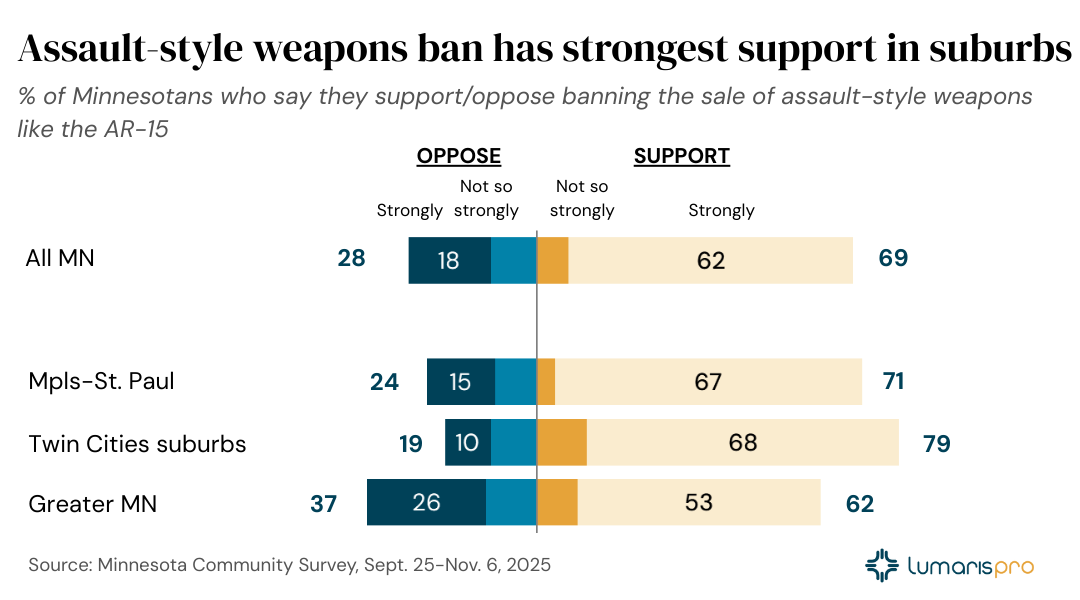
More than two-thirds of Minnesotans (69%) support banning the sale of assault-style weapons such as the AR-15, but the most striking finding may be where support runs highest, according to a Minnesota Community Survey of 1,172 adults conducted Sept. 25–Nov. 6, 2025.

The snapshot

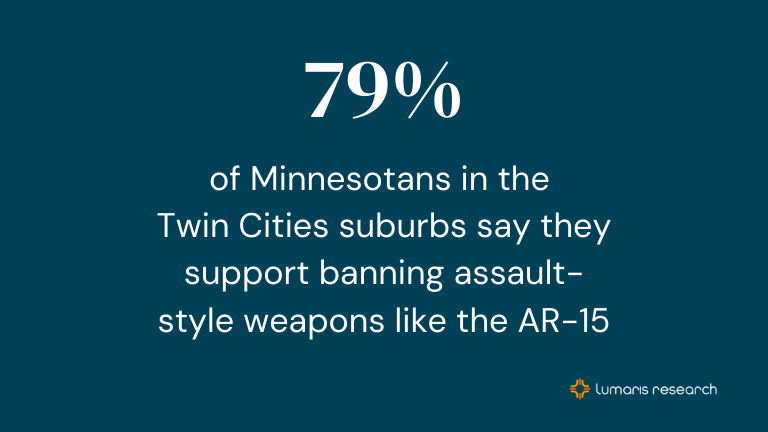
Twin Cities suburbs show the strongest support at 79%, exceeding Minneapolis and St. Paul proper (71%). This inverts the typical urban-suburban pattern in national polling.

The intensity of opinion skews toward support. More than 60% of Minnesotans "strongly support" an assault weapons ban, compared with just 18% who "strongly oppose" it.
The backdrop

Minnesota's divided legislature clouds the future for gun legislation. Following the 2024 elections, the state House is tied. Suburban legislative districts proved decisive, spotlighting suburban opinion on guns during the upcoming session.

Recent tragedies may have shaped public opinion, including the August 2025 Annunciation Catholic Church shooting and the killing of DFL House leader Melissa Hortman. Following these events, legislation has stalled.

How does our survey compare to recent polls? Gallup found 52% national support for a ban in Fall 2024, while a local September 2025 poll found 53% support among Minnesota voters. (The local poll was an online opt-in survey, which research shows can produce less reliable results than probability-based surveys like ours.) In 2023, a Pew Research Center survey found 64% of Americans backed an assault weapons ban.

In our poll, the assault weapons ban polls higher than stricter gun laws in general. When we asked Minnesotans whether gun laws should be "more strict," 63% agreed, 6 points lower than support for the assault weapons ban specifically. This pattern suggests voters may respond more favorably to concrete policies than abstract proposals.

The gender gap across Minnesota

Women help drive suburban support for an assault weapons ban, and suburban men aren't far behind. More than 8 in 10 suburban women (86%) back a ban, compared with 72% of suburban men.

The gender gap is actually larger in Minneapolis-St. Paul proper. Urban women (83%) and suburban women (86%) support a ban at nearly identical rates. The difference lies with men: just 62% of Minneapolis-St. Paul men support a ban, compared with 72% of suburban men.

These patterns align with national polls on women voters. However, a 2024 KFF poll on suburban women voters found gun policy was not among their top priorities at the time.

The partisan splits

The 43-point partisan gap is the largest among any group of Minnesotans. Democrats overwhelmingly support an assault weapons ban (89%), while Republicans are more divided.

Republican crossover deserves attention. While 52% of Republicans oppose the ban, 46% support it, including 36% who strongly support. This suggests the issue may not be as uniformly partisan as national headlines suggest.

The crossover is even more pronounced on this specific policy. Only 33% of Republicans support making gun laws "more strict" in general, but 46% support the assault weapons ban. That 13-point gap shows the specific proposal has broader appeal than the general concept.

The strength of those views differs by party. Among Democrats, 84% strongly support the ban. Among Republicans, 37% strongly oppose it.

The breakdown

Support rises with education level. College graduates are 12 points more likely to support a ban than those with high school education or less.

Income shows a notable divide. A 15-point gap separates the lowest and highest income groups.

Older Minnesotans express the strongest support. Adults 65 and older show 77% support, the highest of any age group. Ages 30-49 show lower support at around 62%.

Worth noting

Lower-income Minnesotans show the softest support of any income group. At 60%, those earning under $30,000 fall 9 points below the statewide average. Strong support is also notably lower in this group (52%) than in higher-income brackets (65% among those earning $150,000+).

These patterns may reflect different relationships to gun ownership, economic priorities, or cultural factors. A Pew Research Center report highlighted how gun ownership motivations differ by region and income, while Baylor University research found connections between economic stress and attitudes toward firearms.

Black Minnesotans show lower support than the statewide average at 60%. This diverges from national polling where Black Americans show higher support for gun restrictions.

The takeaway

Three patterns stand out:

1. Suburban support exceeds the urban core. The Twin Cities suburbs' 79% support runs counter to long-standing national patterns about where gun control measures are most popular, and these suburban districts often determine legislative majorities. This pattern holds across gun policy questions: when we asked about stricter gun laws in general, suburbs again led at 72%, compared with 67% in Minneapolis-St. Paul proper.

2. The party divide is real, but not absolute. The 43-point party gap is substantial, yet 46% of Republicans support the ban. Overall, strong opposition concentrates among Republicans, but real crossover exists.

3. Income shapes views more than you might expect. The 15-point gap between the lowest and highest income groups is the second-largest divide after partisanship, a pattern that deserves attention.

What's next

The Minnesota Senate is expected to vote on gun legislation when the session begins in February 2026. Senate Majority Leader Erin Murphy told reporters she expects lawmakers will weigh in on assault weapons proposals: "I don't think we get through the session without taking a vote on this issue. I don't imagine that we leave the session without taking a vote."

Republican leaders have signaled the ban lacks GOP support. House Republican Floor Leader Harry Niska said: "I don't think there are any Republican House votes in favor of those kinds of proposals."

The gap between public opinion and legislative action is the story to watch. With 79% suburban support and 46% Republican crossover, the survey shows relatively broad support for an assault weapons ban.

About this Minnesota Community Survey

Survey type: Probability online survey panel

Respondents: 1,172 Minnesota adults

Field dates: Sept. 25–Nov. 6, 2025 (primary fieldwork: Oct. 1-31, 2025)

Margin of error: ±3.86 percentage points

Languages: English, Spanish

This survey was paid for by Lumaris Research.


Read our methodology (PDF)


Our terminology page has definitions of income tiers, racial and ethnic groups, education levels and geographic regions.


QUESTION WORDING

ASK ALL

ASSAULTWEAP Would you support or oppose a law in Minnesota that bans the sale of assault-style weapons such as the AR-15?

1 Support banning assault-style weapons

2 Oppose banning assault-style weapons


ASSAULTWEAP_STR Do you [IF ASSAULTWEAP=1 INSERT “support”; IF ASSAULTWEAP=2 INSERT “oppose”] a law in Minnesota that bans assault-style weapons…

1 Strongly

2 Not so strongly


GUNSTRICT As you may know, the Minnesota legislature might propose a bill to make gun laws in the state more strict.

From what you’ve seen and heard, do you…

1 Support making Minnesota guns laws more strict

2 Oppose making Minnesota gun laws more strict


GUNSTRICT_STR Do you [IF GUNSTRICT=1 INSERT “support”; IF GUNSTRICT=2 INSERT “oppose”] making Minnesota’s gun laws more strict…

1 Strongly

2 Not so strongly